Lost and found in the museum
How a jar of “unidentified” tadpoles became a new genus
When you hear about species discovery, most people, especially those born in the US, probably think of a rugged explorer cresting over an alien horizon. Setting foot where no “man” has stepped before. This was never really true, but it has never been less true than today. More often, species are “discovered” in jars on shelves, deep in the recesses of natural history collections.
This is one of those stories.
Summer 2023, at the Smithsonian
I was in Washington, DC, at the Smithsonian’s National Museum of Natural History, working on a project. I was going through their tadpole collection to find tadpoles I wanted for a project on lung loss.
Every time I visit a big collection like that, I always ask to take a peek at the “unidentified section”. Nearly every collection has some version of this shelf, but tadpole collections tend to have big unidentified sections, since they can be really difficult to ID.
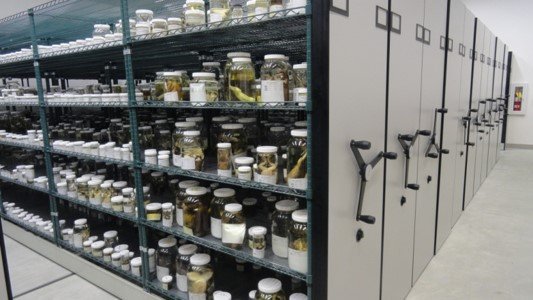
A very ordinary-looking shelf Somewhere in rows like this one sits the next new species, already collected, already preserved, and simply still waiting on the right person to take a second look.
Often these jars are full of tiny, nondescript tadpoles that may never be identified, but sometimes you find something really special.
Flashback to 2006
To explain what I found, I have to back up almost twenty years, to a biologist named Dr. Bruce Means.
Bruce is a naturalist who has spent decades working in Guyana, a country on the northern part of South America. He works on the Pantepui, a region full of remote highlands and table-mountains (“tepui”) in the Guiana Shield. It’s some of the most-difficult terrain to reach in South America, and it keeps producing new species, genera, and even families because so few biologists have ever had the chance to look closely at it. In 2006, during fieldwork on the slopes of Mount Kopinang, Bruce collected some odd tadpoles from a fast-flowing mountain stream. He didn’t know exactly what they were, but he collected them anyway, and deposited them at the Smithsonian. For that, I am very grateful.
FIGURE PLACEHOLDER: coming soon.
After all, this is what I looked like in 2006, for reference, and I was in no position to be climbing Tepuis to find rare tadpoles:

Also 2006 While Bruce was in a Guyanese stream collecting the tadpole that would eventually get its own genus, I was busy learning football wasn’t for me.
After coming back from the field, that jar of tadpoles just sat there. Not lost, exactly. Just unidentified, and waiting.
Some very strange tadpoles
Seventeen years later, I pulled that jar off the shelf. On its label, it just said “Anura: collected on Mount Kopinang, Guyana”.
The tadpoles inside were striking: banded in dark chocolate brown and cream, with an oral disc clearly built for sucking onto rocks in streams, not just grazing.
I knew, right away, that these tadpoles were were something special. They looked kind of like Ansonia tadpoles from Southeast Asia, but like nothing ever described from North of South America. So I called my friend Pedro, the expert on South American tadpoles, and asked what he thought. He agreed these tadpoles were something new. I emailed Bruce next, and so began a very fun year of DNA sequencing, phylogenetics, skull anatomy, and writing.
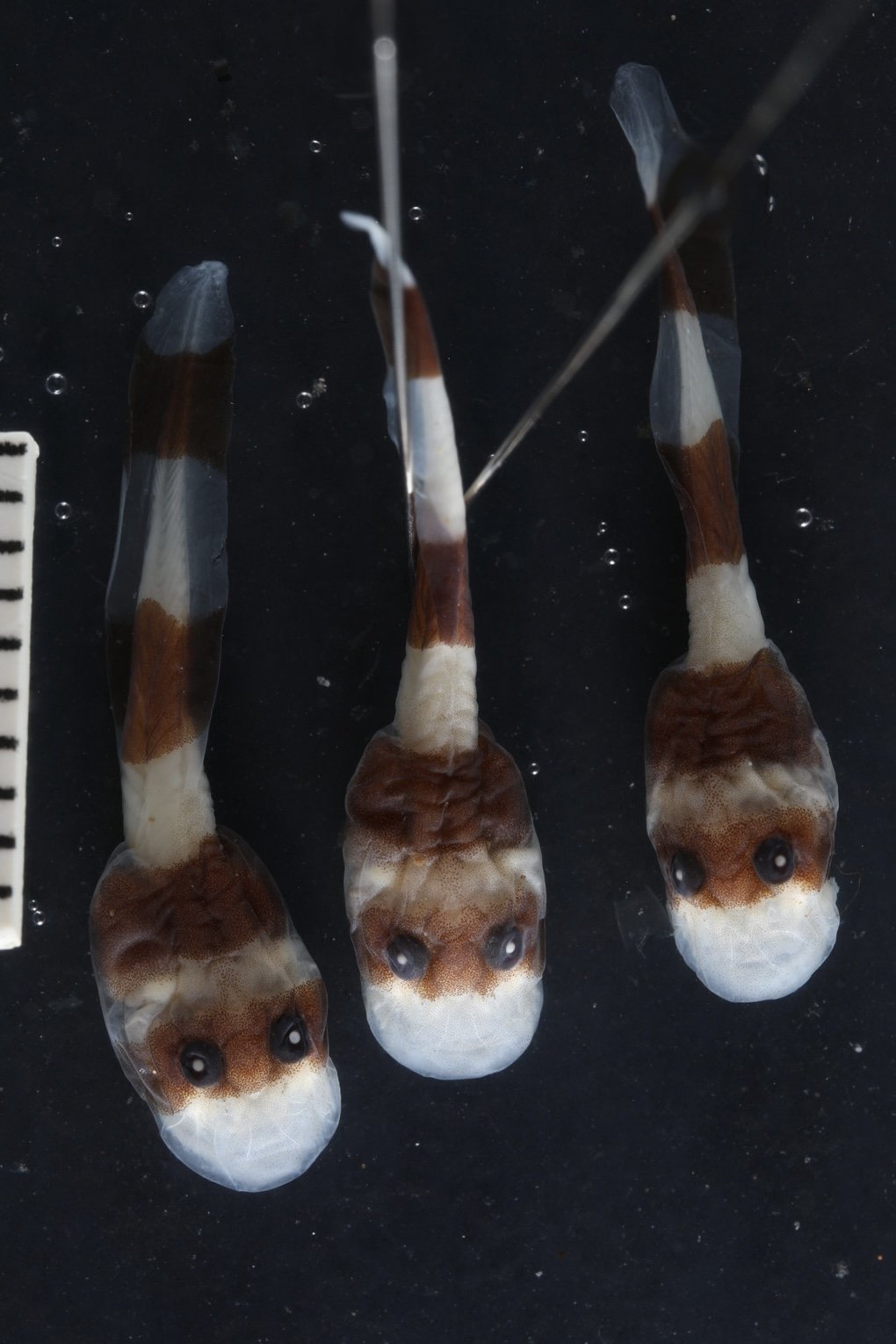
The tadpoles from the jar Striking banded coloration, and a mouth clearly built for clinging to rock in current, not for the ordinary business of scraping algae off a leaf.
It turned out, this wasn’t a new species! The tadpoles’ DNA closely matched a described species known as Rhaebo nasicus, an obscure toad first named in 1903. This species was very enigmatic, having been moved from genus to genus over the years, as none of them quite fit.
Really, Rhaebo?
The striking tadpole was the clue: this thing was no Rhaebo. The color pattern was unlike any other Rhaebo tadpole and the mouth and throat anatomy was totally wrong for the genus. Once we were looking, we also began to find characters in the adult skull that didn’t fit with other Rhaebo toads. Even the larval ecology was off: Rhaebo species are generally pond-and-stream generalists, and this animal was a specialized, sucker-mouthed torrent tadpole clinging to boulders in a waterfall-fed creek.
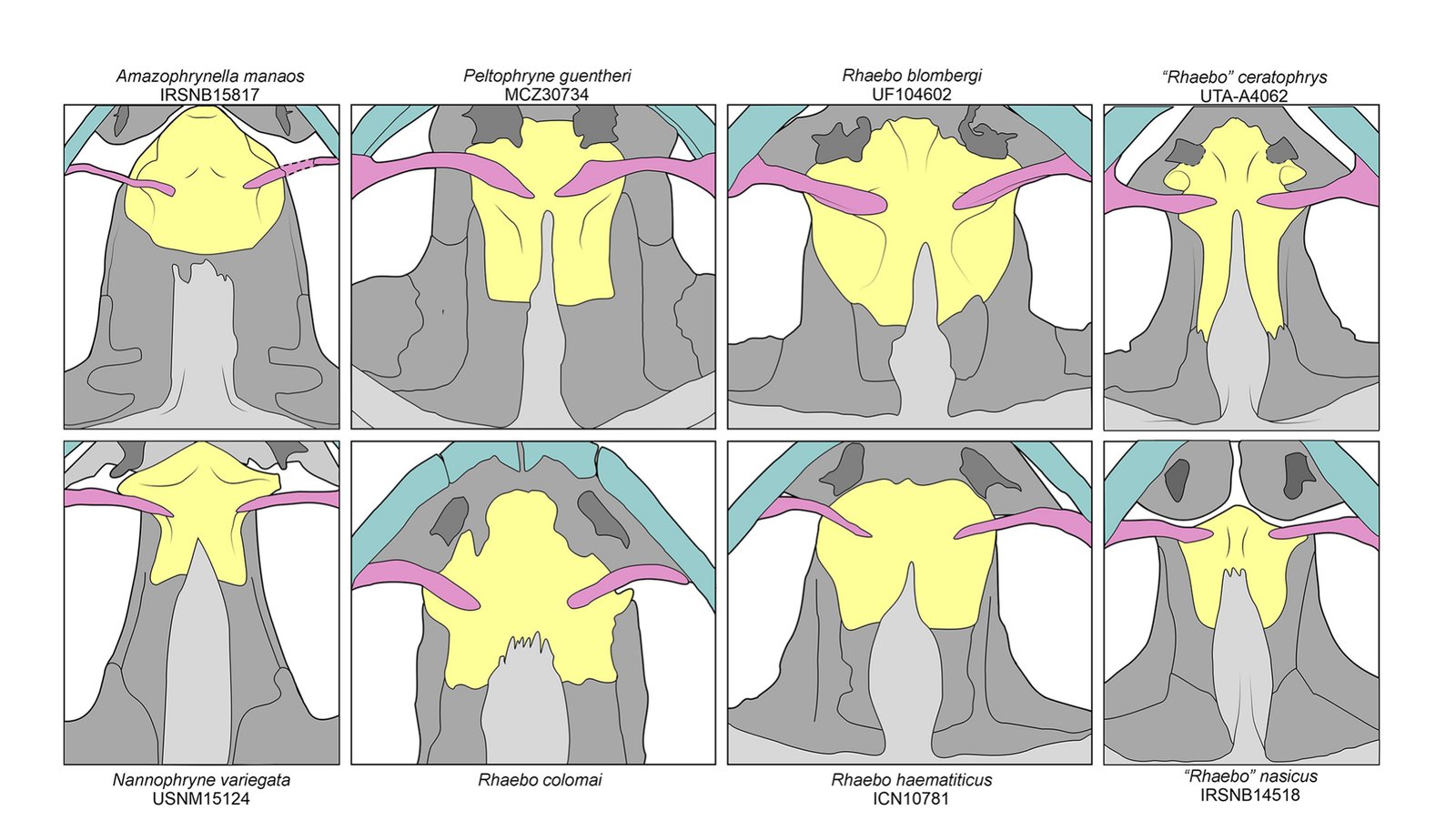
The skull bone that gave it away Fair warning: frog palate bones are a hard sell as a visual. But look at the yellow shape (the sphenethmoid) in the bottom-right panel, “Rhaebo” nasicus, next to Rhaebo haematiticus just to its left. Narrow versus wide. That kind of difference, repeated across several bones, is what a taxonomist actually means by “doesn’t fit the genus.”
Adhaerobufo gen. nov.
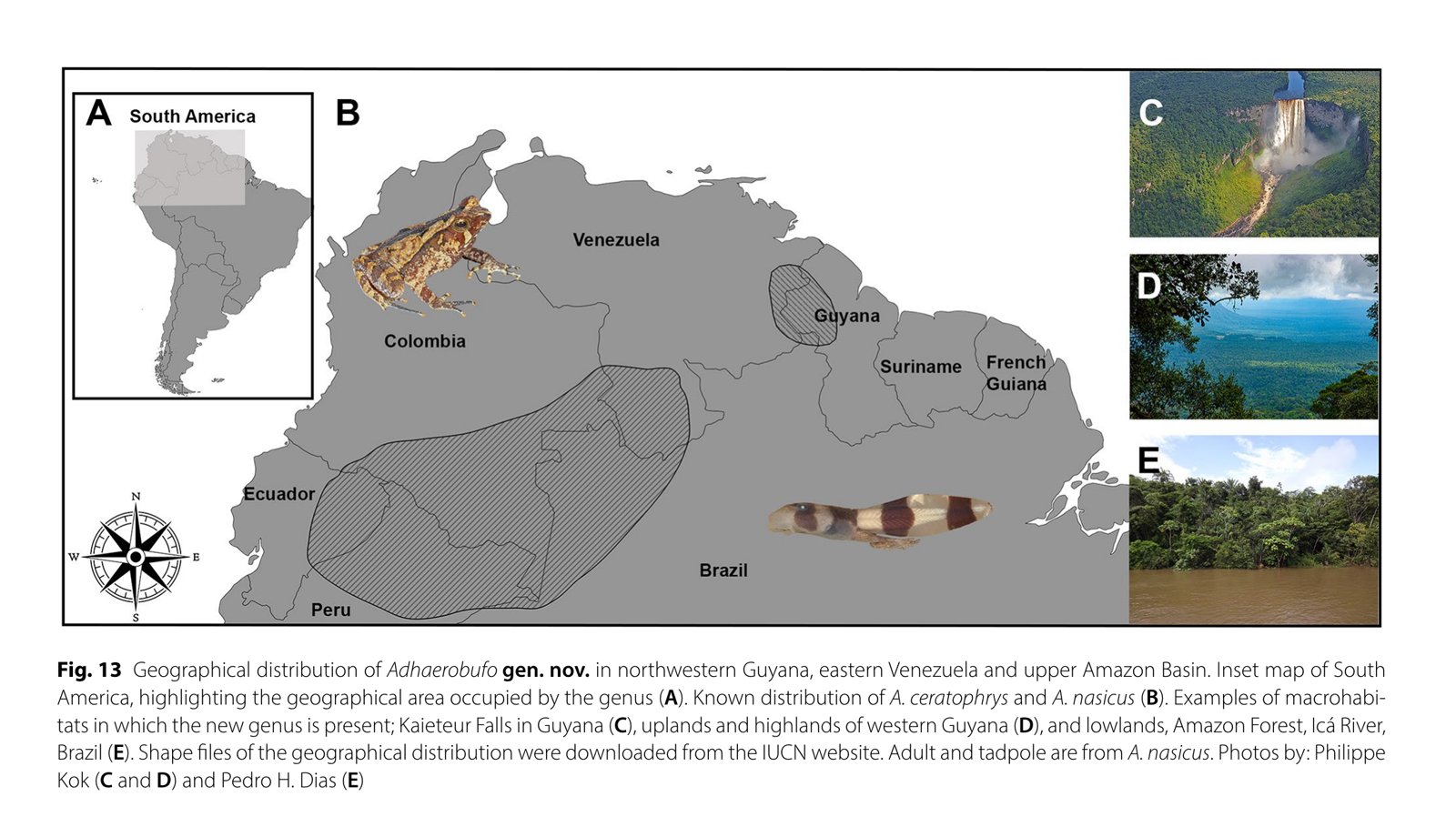
Along with phylogenetic evidence that nasicus was distinct from other Rhaebo, all this evidence convinced us that this tadpole deserved its own genus. So we gave it, and a close relative from the upper Amazon called Rhaebo ceratophrys, a new genus: Adhaerobufo.
The name comes from the Latin adhaerens, meaning adherent or clinging, and bufo, toad. An adherent toad, named for its tadpole. Nearly everything that makes this group distinctive is happening in the tadpole stage.
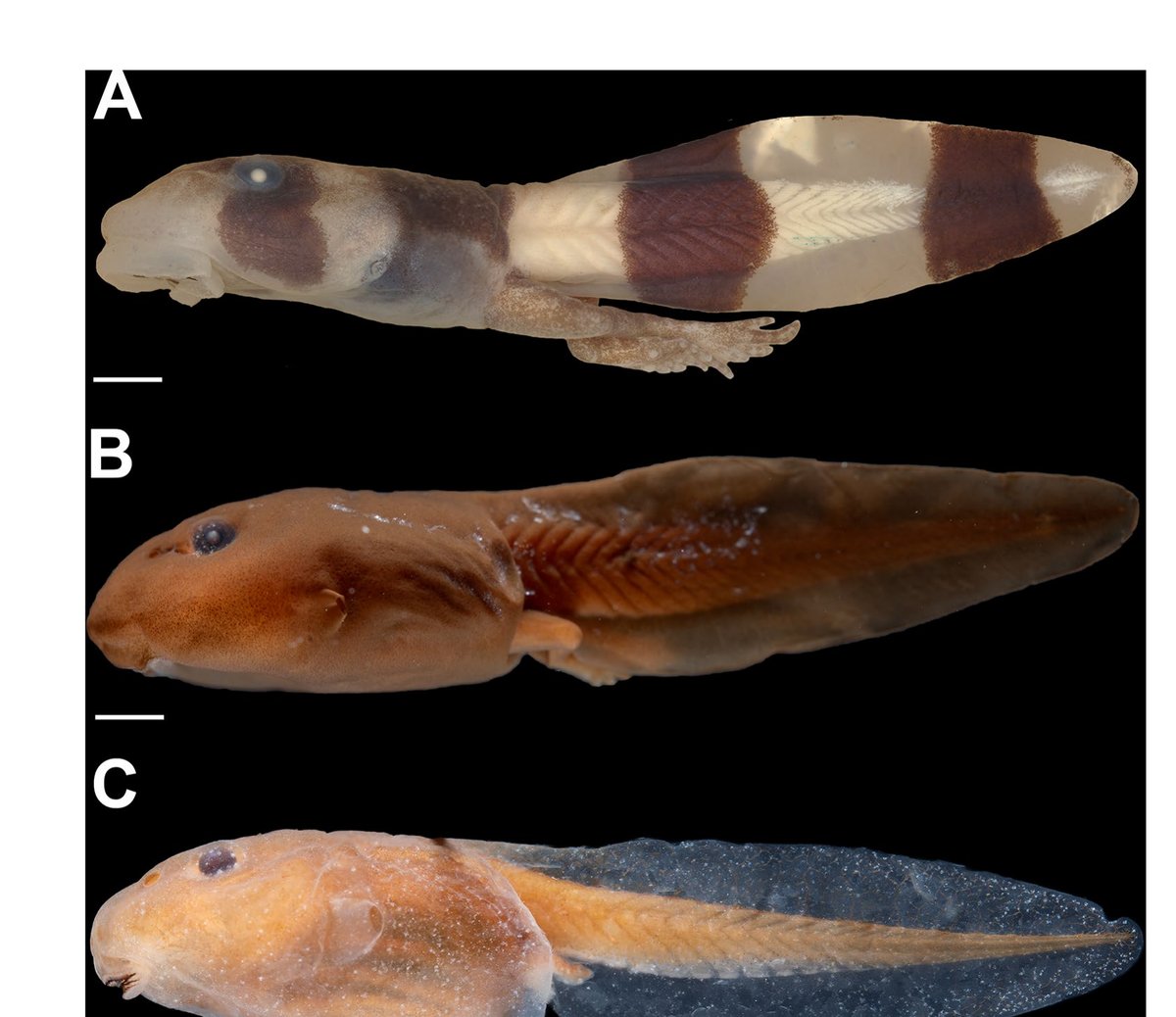
Not exactly a subtle difference, once you line them up Adhaerobufo nasicus (top) next to two ordinary Rhaebo tadpoles, R. caeruleostictus (middle) and R. haematiticus (bottom). Same general toad-tadpole body plan, completely different mouth, body shape, and color.
Lost and found in the museum
Here’s what I’d really love for people to take away from this.
Nobody set out to find a new genus of frog. Bruce didn’t know what he’d collected in 2006, but still collected it. That’s the unglamorous, essential side of taxonomy: collecting and preserving things properly even when you can’t identify them yet, and trusting that eventually the right person will come looking for that jar.
Dias, PH, JR Phillips, MO Pereyra, DB Means, A Haas, and PJR Kok (2024). The remarkable larval morphology of Rhaebo nasicus (Werner, 1903) (Amphibia: Anura: Bufonidae) with the erection of a new bufonid genus and insights into the evolution of suctorial tadpoles. Zoological Letters 10, 17. Open access.